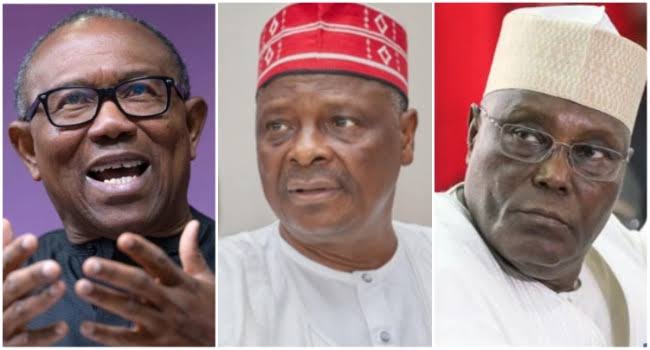
Salihu Lukman, the immediate past National Vice Chairman of the All Progressives Congress (APC), is urging former governors Peter Obi, Rabiu Kwankwaso, and Rotimi Amaechi, as well as former Vice President Atiku Abubakar, to unite ahead of the 2027 general election in order to unseat the ruling APC.
Lukman included other political figures, including former governors Nasir El-rufai, Rauf Aregbesola, Kayode Fayemi, and Ibikunle Amosun, in the planned merger in a statement that was made public in Abuja on Sunday.
In the statement entitled, “Future of Democracy in Nigeria”, Lukman said building the kind of united front capable of moving Nigerian democracy forward requires selflessness on the part of Nigerian political leaders.
The statement reads in part, “What is the future of democracy in Nigeria? Is there any prospect that it can produce leaders who are responsive to national challenges? Being responsive is basically about ensuring that public expenditures are oriented to tackle challenges facing citizens. What are the challenges facing Nigerians today? Poverty, unemployment, insecurity, drugs and substance abuse, millions of out of school children in the North, etc. Not to talk of the additional problems of inflation and the crash of the value of incomes especially in the last one year under the leadership of President Asiwaju Bola Ahmed Tinubu.
“Although some officials of the government of President Asiwaju Tinubu have attempted to explain the current hardship Nigerians are facing with reference to the bad economy inherited from the previous administration of former President Muhammadu Buhari, the reality is that both are APC Governments. If anything, APC became very popular in Nigeria on account of the failings of the PDP. What were the failings of the PDP? The failings of the PDP are reflected in the same way today’s challenges are manifesting. If the truth is to be told, whatever was the failings of PDP in 2015, it was less grievous than what it has become under APC in 2024.
“No doubt, former President Buhari had his problem as a leader. However, whatever was estimated to be his failure should be the shared responsibility of APC leaders in varying degrees, including President Asiwaju Tinubu. No leader of APC should attempt to distance himself/herself from the failure of the Buhari era, certainly, not President Asiwaju Tinubu. In one way or the other, APC leaders, without exception, are ‘beneficiaries’ of the Buhari era, just as some of them could claim to be victims. On balance however, APC leaders benefited more from the Buhari era than being victims. At least electorally, former President Buhari made it possible for APC to defeat the PDP. Without former President Buhari, the defeat of PDP in 2015 would have been almost impossible, and by extension, arguably, would have been difficult, if not impossible for President Asiwaju Tinubu to become President of the Federal Republic of Nigeria.
“Unfortunately, having defeated the PDP in 2015, APC failed to produce the needed collective leadership required to manage the machinery of governments produced by the party at all levels. Gradually, APC succeeded in turning democracy on its head. Instead of producing democratic leaders, elected leaders increasingly became emperors and overlords. State machinery became captured and privatised to almost exclusively only serve the interests of elected representatives.
“The reality is that Nigerian democracy has legitimised the problem of state capture whereby the machinery of government at all levels are being privatised and oriented only to serve the narrow interests of elected officials. Public resources and funds are allocated or diverted to benefit elected officials. The term, ‘state capture’ is, according to Wikipedia, ‘first used by the World Bank, around the year 2000, to describe the situation in certain Central Asian countries making the transition from Soviet communism.
“Beyond the APC, other parties, including the PDP, Labour Party, New Nigeria Peoples Party (NNPP), which are today’s main opposition parties, are being manipulated into operating in crisis modes. Their capacity to moblise Nigerians and lead any political opposition against the APC is being undermined. Consequently, President Asiwaju Tinubu is having a field day, practically having his way even when he takes wrong decisions with devastating impact on the lives of Nigerians. It is almost as if another political reality like what we had in 1998 during the era of late Gen. Sani Abacha with parties aptly fitting the description of late Chief Bola Ige of being ‘fingers of a leprous hand’ is today’s Nigerian reality.
“The risk of state capture in Nigeria extending to the Independent National Electoral Commission (INEC) is high given that the tenure of Prof. Mahmud Yakubu, current INEC Chairman will end before the 2027 general elections. And with the way President Asiwaju Tinubu betrayed any commitment to appointing competent people into his government, the possibility of appointing a new INEC Chairman who will facilitate the capture of INEC is high.
“Already, within just one year, President Asiwaju Tinubu’s government has moved into the 2027 electioneering mode. Instead of working to earn the support of Nigerians, President Asiwaju Tinubu seems to be leaned on recruiting political merchants whose stock in trade is limited to fanning embers of divisive politics in the country and blackmailing political opponents. Such disposition only lends credence to the prospects of rigging elections in the country.
“So far, with the way President Asiwaju Tinubu has conducted himself as President of Nigeria in the last one year, he has deviated from any credential of being an Awoist. Given how he has mismanaged what could have earned him a legendary status as a leader who courageously ended the corrupt racketeering of petroleum subsidy, and unable to humbly find a way out of what has now become a national tragedy producing endless downward swing in the living conditions of Nigerians, the gap between him and the Chief Obafemi Awolowo is the contrast between darkness and sunlight. Chief Awolowo wouldn’t have contemplated to declare an end to petroleum subsidy in Nigeria without any plan.
“Instead of building schools, recruiting teachers and providing books and teaching materials to harness the productive potentials of our population, elected leaders are more disposed to outright embezzlement of government resources so much so that today there are strong speculations of state governors converting substantial parts of their monthly federal allocations to US Dollars at black market rates, which is responsible for why the value of the Naira remain weak.
“As much as the issue of governors converting states monthly federal allocation is a speculation, there are instances whereby the Economic and Financial Crime Commission (EFCC) accused one of the Governors of one of the states in North-Central of diverting more than N20 billion Naira of bailout funds to the state in 2021 to private account. That is the extent to which the incidence of ‘state capture’ at state level has ‘strengthen … economic positions’ of so-called elected leaders to the detriment of citizens. In fact, that is the challenge facing Nigerian democracy.
“If the phenomenon of ‘state capture’ is becoming a federal reality under the APC and President Asiwaju Tinubu, is Nigerian democracy moving to a stage whereby the resources of the Federal Government will almost become the personal resources of the President? Should that be the case, what will be the remedy?
“So long as the aspirations of Nigerian politicians is only limited to winning elections and producing new elected leaders, Nigerian democracy will be unable to reverse the phenomenon of ‘state capture’, which is now in the advanced stage of taking over the Federal Government.
“Unfortunately, given the advanced stage of ‘state capture’ at Federal level, most political leaders, including the leading opposition leaders such as Alh. Atiku Abubakar, Mr. Peter Obi and Sen. Rabiu Musa Kwankwaso are all operating in isolation to one another. APC leaders such as former Vice President Yemi Osinbajo, Chief Rotimi Amaechi, Dr. Kayode Fayemi, Sen. Ibikunle Amosun, Mal. Nasir El-Rufai, Ogbeni Rauf Aregbesole etc. who are more like political orphans on account of being excluded from the President Asiwaju Tinubu government have been pushed to the peripheral edges of Nigerian politics.
“Although, there are some indicative political activities taking place around some of these political leaders, it has not graduated to the level of commitment to build the kind of strong political parties capable of threating the APC and President Asiwaju Tinubu, which is needed to guarantee the future of Nigerian democracy.
“Building strong political parties in the country capable of responding to the challenges facing citizens and reversing the phenomenon of ‘state capture’ at all levels is about political leaders agreeing to form a united front across all parties. Forming a united front is about recognising the shortcomings of individual leaders and being able to forgive misgivings of the past. Ability to forgive misgivings of the past is a fundamental requirement for political leaders to be able to orient themselves and provide the needed leadership for national reconciliation. Inability of APC, both under former President Buhari and now under President Asiwaju Tinubu to orient itself on the path of national reconciliation represent one of the big political failure ever experienced in the country.
“Given the way the failure of APC has widen the country’s fault lines, it is important that considerations for developing united political front painstakingly aspire to unite political leaders across the country. For instance, the way, the people of the South-East rejected the APC since 2015 must be redressed.
“Any new united political front should gain some measure of high acceptability in virtually all parts of the country. The requirement for high acceptability from all sections of the country should humble all political leaders in the country, especially Alh. Atiku Abubakar and Mr. Peter Obi not to exploit the need for such a united front by imposing their Presidential ambitions. In the same vein, other APC leaders such as Prof. Osinbajo, Chief Amaechi, Dr. Fayemi, Mal. El-Rufai, Sen. Amosu, etc. (APC political orphans) who in one way or the other have ambitions to become Nigeria’s President must bury such ambitions, at least not during the negotiation to form the united political front.
“The point must be recognised that building the kind of united front capable of moving Nigerian democracy forward require selflessness on the part of Nigerian political leaders. Beyond the requirement of selflessness, to overcome the experience we had under APC whereby after producing the united front, individual leaders superimposed their ambitions to become President the way both former President Buhari and President Asiwaju Tinubu did, the negotiation for the new united political front should prioritise building a party that can serve as a collective platform for negotiations. Leadership of such a party must not be devalued and left only to political surrogates whose mission is only to return their godfathers as candidates of the party for elections.
“If that is to be achieved, the National Chairman of the party must have the stature of a President in all considerations. Other members of the leadership of the party at all levels must have the stature corresponding to respective public servants. The party must be well resourced financially based on capacity to mobilise financial resources and invest in political work, including electioneering process in lines with extant provisions of Nigeria’s laws.
“These are fundamental preconditions for conferring dignity in the management of party work. Agreements reached based on decisions of party organs can be made binding on everyone and the turnover of party leaders moving take positions in government can be reduced. For that to be achieved, issues of funding must be resolved such that no leader of the new political front or party should be the main source of party funding. As much as possible, funding for election should be democratised. Candidates produced by the party must not be allowed to fund their campaigns.
“Absence of cooperation among political leaders is responsible for the rising incidences of bad governance in the country and is eroding the basis Nigerian nationhood. Once democracy cannot respond to challenges facing citizens, Nigeria as a sovereign entity will be irrelevant and questionable.
“Nigerian opposition political leaders, including the orphaned leaders of APC who are excluded in the APC government of President Asiwaju Tinubu, notably Alh. Atiku Abubakar, Mr. Peter Obi, Sen. Rabiu Musa Kwankwaso, Prof. Yemi Osinbajo, Chief Rotimi Amaechi, Dr. Kayode Fayemi, Sen. Ibikunle Amosun, Mal. Nasir El-Rufai, Ogbeni Rauf Aregbesola, etc. must unite to rescue Nigeria. Whether producing the united political platform can be achieved through merger of existing parties, forming a new party or rebranding any of the existing parties is a decision that can be determined if leaders agree to come together and unite.
“First thing first, political leaders must recognise that rescuing Nigeria from its current slippery slope is about teamwork and partnership. It is only through conscious and committed teamwork that we can rebuild important democratic institutions such as political parties, legislatures, electoral bodies, and other institutions, which could hold elected officials accountable. Beyond holding elected officials accountable, it is only when we have strong political parties with leaders who run affairs of the party based on provisions of party constitutions that processes of leadership selection can be sanitised in the country.
“Political leaders in Nigeria, notably Alh. Atiku Abubakar, Mr. Peter Obi, Sen. Rabiu Musa Kwankwaso, Prof. Yemi Osinbajo, Chief Rotimi Amaechi, Dr. Kayode Fayemi, Sen. Ibikunle Amosun, Mal. Nasir El-Rufai, Ogbeni Rauf Aregbesola, etc. must answer the question as to whether they want to allow their narrow political ambition to continue block the path for the democratic development of Nigeria? Or why shouldn’t they aspire to register their name as political leaders who were able to rise to the occasion in Nigeria’s hour of national need by coming together to forge a united political front, which could transformed Nigeria’s democracy and reverse the phenomenon of ‘state capture’ that produced ‘small corrupt groups’ of used ‘government officials’ who are appropriating ‘government decision-making to strengthen their own economic positions’?
“May God unite all patriotic political leaders in Nigeria across all parties, including orphaned leaders of APC and strengthen them with the capacity to be selfless and commit themselves to building all the democratic institutions that can make elected leaders and governments at all levels accountable to citizens based on which Nigeria’s democracy is effectively capable of responding to national challenges and meeting the expectations of citizens. Amin!”