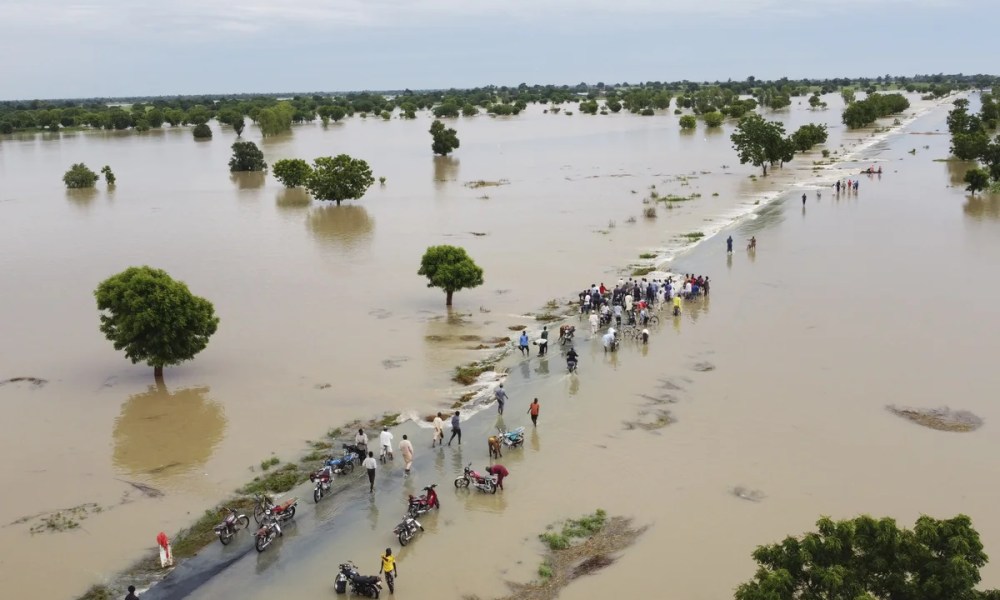
The Federal Government has issued a fresh flood warning following reports from the Nigeria Hydrological Services Agency (NiHSA) indicating dangerously high water levels along the River Niger and River Benue, with the potential for major flooding in Kogi, Anambra, Delta, Benue, Adamawa, Niger, and Bayelsa states.
Speaking during a press briefing in Abuja on Thursday, NiHSA’s Director General and Chief Executive Officer, Umar Muhammed, said the agency’s monitoring results showed alarming hydrological readings that could trigger severe flooding in several regions if not promptly addressed.
“At the moment, our hydrological monitoring shows high water levels along parts of the Niger and Benue Rivers, with the possibility of localised flooding in Kogi, Anambra, and Delta states. We advise residents in flood-prone areas to remain vigilant and follow official advisories,” Muhammed said.
He added that the agency’s recent water quality assessment had exposed serious contamination in some shallow wells as floodwaters infiltrated underground sources. “Our recent water quality assessment during flood evaluation exercises revealed contamination in some shallow wells caused by floodwater intrusion. We call for stronger collaboration among relevant ministries, humanitarian partners, and local authorities to ensure the provision of safe drinking water to affected communities,” he stated.
NiHSA’s latest warning has renewed national anxiety over Nigeria’s readiness to tackle seasonal flooding, which continues to devastate communities annually despite repeated early warnings. The agency urged all tiers of government to act swiftly to reduce the anticipated humanitarian and infrastructural impact.
According to Muhammed, NiHSA is implementing a Five-Year Strategic Action Plan to reform its operations, enhance technological capacity, and strengthen coordination among stakeholders. “NiHSA is also strengthening its zonal and field offices to bring our services closer to the people. All these efforts are in line with the Renewed Hope Agenda of President Bola Ahmed Tinubu, which emphasizes innovation, accountability, and measurable results,” he said.
The DG assured that NiHSA remains committed to a data-driven, preventive approach aimed at protecting lives and critical assets from climate-related disasters. He explained that the agency has upgraded its early warning systems, integrating satellite imagery, digital modelling, and real-time data collection to provide more accurate flood forecasts.
Across the country, NiHSA maintains a wide network of hydrological and groundwater monitoring stations. These provide real-time information for forecasting, planning, and decision-making. Through hydrogeological mapping, river discharge measurements, and floodplain studies, we help states and local communities make informed choices about land use, infrastructure, and water management,” he explained.Muhammed further described the Annual Flood Outlook as one of NiHSA’s most important products, providing yearly projections on likely flood scenarios across all states to enhance national preparedness.
He also highlighted the importance of inter-agency cooperation, noting that NiHSA maintains strong partnerships with the Nigerian Meteorological Agency (NiMet), National Emergency Management Agency (NEMA), and international bodies such as the World Meteorological Organization, UNESCO, ECOWAS, and the International Atomic Energy Agency to strengthen capacity and align Nigeria’s practices with global standards.
Supporting the DG’s remarks, Stephen Jabo, Technical Adviser to the NiHSA DG, warned that Benue, Adamawa, Niger, and Bayelsa are still at high risk of serious flooding as river levels remain elevated.
He cautioned that, “What states can do for those communities located along the riverbanks of Rivers Niger and Benue is to sensitise them to remain on high alert, move to higher ground, and be aware of the locations of designated flood camps. In the event of flooding, they should be ready for evacuation.”
Jabo further advised that although the rainy season is expected to end in most regions by November, communities must remain on guard as heavy rainfall and water discharge from upstream sources could still trigger late-season floods.He warned residents against walking or swimming through floodwaters and urged state governments to clear blocked drainages to facilitate proper water flow and minimise damage.
The NiHSA alert serves as a stark reminder that Nigeria’s flood crisis—driven by climate change and poor environmental management—remains a looming threat demanding urgent, coordinated action.