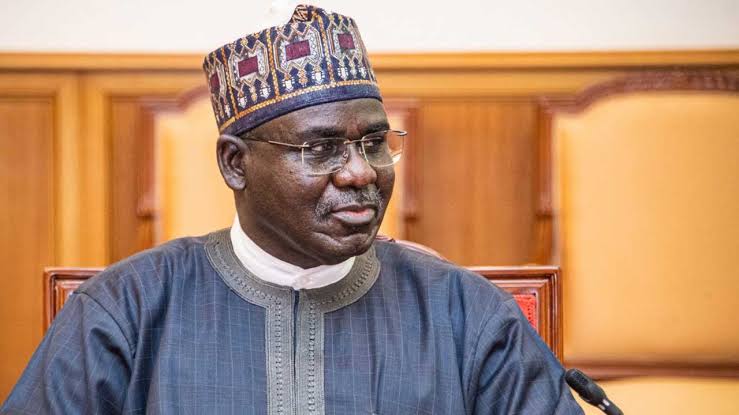
Former Chief of Army Staff, Lt. Gen. Tukur Buratai (retd.), has cautioned the United States against any military intervention in Nigeria, describing claims of an ongoing “Christian genocide” as a dangerous misrepresentation of the country’s realities.
Buratai, who served as Nigeria’s Army Chief during intense counter-insurgency operations against Boko Haram and other terrorist groups, issued the warning in an opinion article published on Sunday, titled “Mutual Security, Shared Prosperity: A Strategic Path Beyond the U.S.–Nigeria Stalemate.”
His remarks followed reports that Washington was considering a military operation in Nigeria in response to alleged religious persecution.
Buratai warned that such a move would be a grave strategic error, saying, “The current confrontation between the United States and Nigeria, ignited by the spectre of foreign military intervention, represents a perilous crossroads. While it presents the danger of catastrophic miscalculation, it also offers the potential for a more resilient and mutually advantageous alliance.”
He dismissed the notion of a Christian genocide as “a dangerously reductive distortion of Nigeria’s intricate realities,” adding that any military action by the U.S. would undermine long-term diplomatic and security cooperation between both nations.
“For the United States, acting on this fallacy would be a profound strategic blunder; for Nigeria, it constitutes an existential menace,” Buratai wrote.
He cautioned that coercive tactics would “weaken, not strengthen, American credibility,” portraying Washington as a neo-colonial power rather than a trusted partner. “Public ultimatums and intimidation directed at a sovereign nation of Nigeria’s stature, Africa’s largest economy and most populous democracy, actively propel a nation of over 200 million people, and potentially the entire ECOWAS, deeper into the strategic embrace of rivals like China and Russia,” he added.
Instead, the retired general urged the U.S. to replace “public coercion” with “resolute, private collaboration,” emphasizing intelligence-sharing, verified data, and targeted assistance in counter-insurgency efforts.
He also encouraged bipartisan congressional visits to Nigeria to better understand the conflict dynamics, insisting that “policy must be grounded in verified data, not inflammatory fiction.”
Highlighting Nigeria’s economic potential, Buratai said projects like the Dangote Refinery exemplify the country’s capacity for self-reliance and should be viewed as opportunities for partnership rather than threats. “A stable, prosperous Nigeria is an infinitely more valuable ally than a fractured, dependent state,” he noted.
Buratai called on the Nigerian government to respond with “a swift, sophisticated, and assertive campaign” to counter the genocide narrative. He urged the dispatch of delegations comprising respected Christian and Muslim leaders to engage U.S. policymakers directly.
“The threat to Nigeria’s sovereignty and corporate existence demands that every citizen, Muslim and Christian alike, rally with unwavering unity behind the government,” he said. “A nation that conquers its own challenges and stands united against internal divisions offers no justification for foreign intrusion.”
His comments came shortly after former U.S. President Donald Trump announced via his Truth Social platform that Nigeria had been redesignated as a “Country of Particular Concern” over what he described as “an existential threat to Christianity.”
In response, the Nigerian government denied allegations of genocide, affirming that the country’s constitution guarantees freedom of religion and that President Bola Tinubu’s administration remains committed to ensuring equality and protection for all faiths.