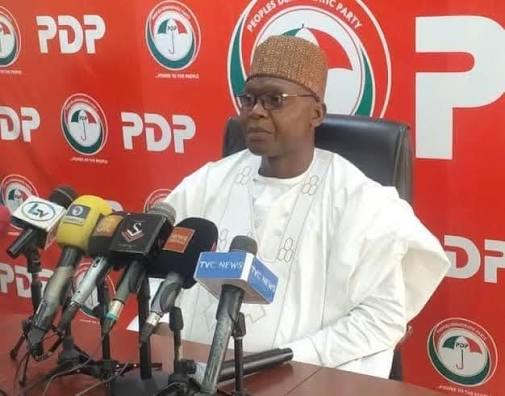
The Peoples Democratic Party (PDP) has outrightly dismissed the latest ruling from the Federal High Court in Abuja barring its national convention, describing the order as “a waste of time”.
The party has vowed to proceed with its preparations for the elective national convention slated for November 15 and 16, asserting that it is guided by a superior, subsisting Supreme Court judgment regarding its internal affairs.
Ibrahim Abdullahi, the Deputy National Publicity Secretary of the party, reacted strongly to the ruling in an interview with reporters on Tuesday. He firmly insisted that the party could no longer be swayed by “procured judgments,” maintaining that the PDP was formed by Nigerians, not by the courts.
Regarding the Federal High Court order, Abdullahi stated: “The judgment is a waste of time. We have gone too far to be asked to stop.”
He added: “We are not a political party founded by a court of law but by Nigerians, and we are expected to listen to Nigerians, not to procured judgments.”
Abdullahi stressed that the party’s decision to move forward is rooted in established legal precedent: “There’s no way they will stop us. We have a subsisting Supreme Court judgment that says the internal affairs of parties are within their exclusive rights, and we’re adhering to that. Even if anyone chooses to ignore the Oyo State High Court order that authorised us to go ahead, they cannot ignore the Supreme Court’s decision. We cannot be playing to the gallery of conflicting court decisions. We’ve gone too far; there’s no stopping us.”
He concluded with a defiant posture: “Let them wait. When we finish, let them try not to recognise it, if they can. In any case, they can always appeal the judgment, but we are moving ahead.”
Abdullahi’s comments came shortly after Justice Peter Lifu of the Federal High Court in Abuja on Tuesday barred the PDP from holding the convention, a decision that directly contradicts an earlier ruling by the Oyo State High Court, which had cleared the party to proceed with the exercise. Legal analysts have widely described this scenario of contradictory orders as an abuse of court process.
Justice Lifu’s order specifically restrained the PDP from holding the convention in Ibadan and directed the Independent National Electoral Commission (INEC) to refrain from supervising, monitoring, or recognising the outcome of the exercise where national officers are to be elected.
The order was given during the hearing of a suit filed by national chairmanship aspirant and former Jigawa State governor, Sule Lamido. Lamido sought an interim injunction, alleging that he had been denied the opportunity to purchase the chairmanship nomination form, arguing that the process violated his rights and the party’s constitution.
Justice Lifu said the order became necessary due to the PDP’s alleged failure to comply with the mandatory 21-day notice and other conditions required for holding such conventions. The judge ruled that the “balance of convenience” favoured Lamido, cautioning that the rule of law must be strictly followed to safeguard democracy.
Justice Lifu’s decision is the latest in a series of judicial interventions against the convention. Weeks prior, on October 31, Justice James Omotosho also barred the PDP from holding the convention over alleged irregularities in the conduct of state congresses in about 14 states.
Conversely, on November 4, Justice O. A. Akintola of the Oyo State High Court issued a contrary order approving the convention, pending the determination of a suit filed by a PDP member in Oyo State, Folahan Malomo Adelabi. Adelabi’s suit listed the PDP, the Acting National Chairman Ambassador Umar Damagum, Governor Umaru Fintiri (on behalf of the NCOC), and INEC as respondents.