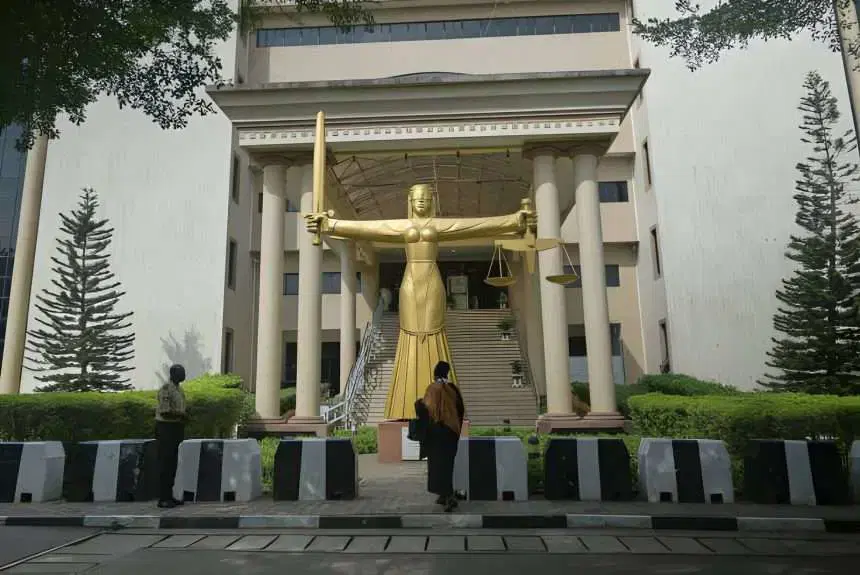
A Federal High Court in Abuja has delivered a landmark judgment today, Friday, April 24, 2026, ruling that the Nigeria Police Force and the Federal Road Safety Corps (FRSC) lack the legal authority to impose fines on motorists for certain traffic-related breaches without a court order.
The ruling, delivered by Justice Hauwa Yilwa, specifically addressed the enforcement of the Third-Party Motor Vehicle Insurance Act, but the broader implications are already sparking intense legal debate across Nigeria.
The Distinction: Enforcement vs. Sanctioning
The court’s decision hinged on a critical distinction between the power to check compliance and the power to punish:
- Enforcement Powers Upheld: The judge affirmed that both the Police and the FRSC retain their statutory powers to stop, search, and verify if a motorist has valid third-party insurance.
- Sanctioning Powers Denied: Justice Yilwa held that these agencies “outrightly lack the powers to impose fines” on vehicle owners in the course of such enforcement. The court ruled that only a court of competent jurisdiction has the legal mandate to penalize or sanction citizens.
- The Injunction: The court issued an order of perpetual injunction restraining the Inspector-General of Police (IGP), the Police Force, and all their officers, as well as the FRSC, from imposing such fines on motorists.
The Legal Origins of the Suit
The case (marked FHC/ABJ/CS/291/2025) was initiated by human rights activist and lawyer Deji Adeyanju.
- The Objective: Adeyanju sought to curb what he described as “arbitrary fines and extortion” following a nationwide police drive to enforce third-party insurance compliance that began in early 2026.
- The Victory: Speaking to journalists after the ruling, Adeyanju noted that while the court did not strip the police of their enforcement powers entirely, the judgment effectively ends the practice of “roadside sentencing.”
Wider Implications and Legal Debate
This judgment follows a similar legal precedent set in late 2024 and upheld by the Court of Appeal in January 2026, which barred the Vehicle Inspection Office (VIO) from stopping motorists and imposing fines in Abuja.
- Defense Response: Counsel for the Police and FRSC, Victor Okoye, has already signaled plans to challenge the ruling at the Court of Appeal, arguing that the suit was improperly constituted and that the court lacked jurisdiction.
- State vs. Federal Law: Legal analysts suggest that while this ruling is binding in Abuja, its application in states like Lagos (which has specific transport sector reform laws) may be contested, as seen during the 2024 VIO ruling.