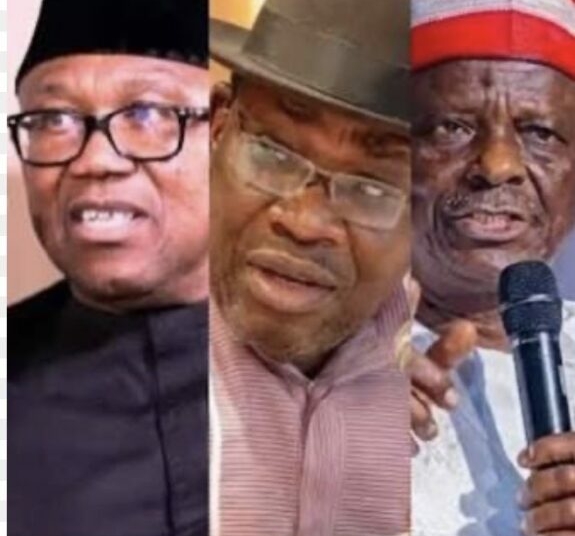
Political tension within the opposition coalition has escalated sharply as the Obi-Kwankwaso Movement (OK Movement) flatly refused to collapse or hand over its parallel national campaign structure to the Nigeria Democratic Congress (NDC) ahead of the 2027 general elections.
The clash erupted after NDC National Leader, Senator Seriake Dickson, and National Chairman, Senator Cleopas Moses, publicly disowned a 59-member Presidential Campaign Council previously announced by the OK Movement. Party leadership labeled the independent setup “nonsensical” and unauthorized, insisting that support groups must remain subordinate to the party’s central leadership rather than running parallel operational structures.
Hitting back in a hard-hitting statement, the Director-General of the OK Movement, John Ughulu, declared that the organization will never surrender its national, state, local government, and ward structures to the NDC or any other political body. Ughulu clarified that the movement brings together members from various political backgrounds backing the presidential aspirations of Peter Obi and Rabiu Kwankwaso. While respecting the NDC’s constitutional authority over its internal party affairs, he maintained that political alignment does not mean organizational submission.
“We did not build the OK Movement overnight, and no individual can simply declare our structure dissolved or absorbed,” Ughulu warned, promising to resist any attempt to disenfranchise its grassroots members through democratic means.
With both sides digging in their heels over who controls the campaign machinery for the 2027 presidential ticket, this deepening rift poses a major test for the opposition’s unity. Can the NDC and the OK Movement find common ground before 2027, or will this structural war dismantle their alliance from within? Share your thoughts below!