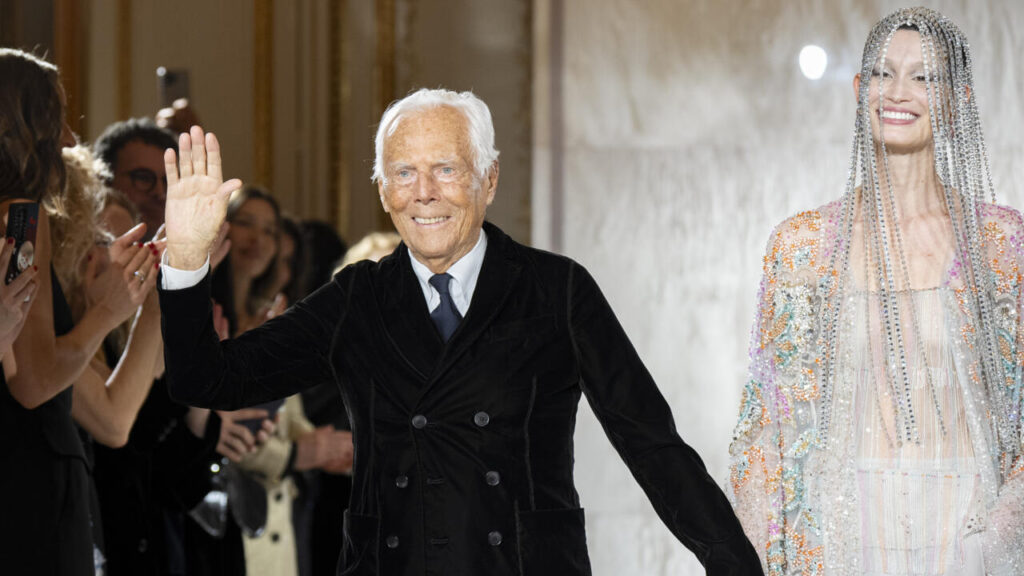
The global fashion industry is mourning the loss of Giorgio Armani, the iconic Italian designer whose name became synonymous with timeless elegance, sharp tailoring, and minimalist sophistication. Armani, often celebrated as “Re Giorgio” or “King Giorgio”, passed away at the age of 91, his company announced on Thursday.
“With infinite sorrow, the Armani Group announces the passing of its creator, founder, and tireless driving force: Giorgio Armani,” read the official statement. His death marks the end of an era, as the fashion world bids farewell to a man whose influence reshaped style on a global scale.
The Making of a Style Legend
Born in Piacenza, Italy, in 1934, Armani rose from humble beginnings to become one of the most recognizable figures in fashion history. His early career in window dressing and menswear design laid the foundation for his unique aesthetic: clean lines, neutral tones, and understated luxury.
By the 1970s, Armani had launched his own label, and within a decade, he had transformed global fashion. His philosophy was simple yet groundbreaking: elegance should be effortless, and clothing should empower the wearer. This belief resonated with generations of fashion lovers, establishing Armani as the pioneer of modern Italian style.
Power Dressing and Hollywood Fame
Armani’s career-defining moment came in 1980 when he designed the wardrobe for Richard Gere in the film American Gigolo. The sharp suits and fluid tailoring caught the world’s attention, propelling Armani into Hollywood’s spotlight. Soon, his designs were dominating red carpets, worn by stars such as Cate Blanchett, Julia Roberts, and Leonardo DiCaprio.
His suits also revolutionized professional wardrobes. Armani turned “power dressing” into an international phenomenon, giving men and women clothing that symbolized authority, confidence, and sophistication. For many executives and public figures, owning an Armani suit became a rite of passage.
A Fashion Empire
What began as a single label quickly evolved into a multi-billion-euro empire. Armani expanded his brand into multiple lines — including Emporio Armani, Armani Exchange, and Armani Privé — catering to different markets while maintaining his signature touch of elegance.
Beyond clothing, he extended his vision into accessories, fragrances, sports partnerships, and even luxury hotels. Unlike many of his peers who sold their labels to global conglomerates, Armani kept his business private, maintaining complete creative control until the very end.
With an estimated net worth of more than €2.3 billion, Armani’s empire remains one of the most successful independent fashion houses in the world.
A Perfectionist With a Vision
Known for his precision and perfectionism, Armani was involved in every detail of his brand. From the cut of a jacket to the lighting at his runway shows, he personally oversaw creative decisions. Industry colleagues often described him as relentless, disciplined, and uncompromising in his pursuit of excellence.
In recent months, however, Armani’s health had been declining. For the first time in his career, he missed Milan’s Men’s Fashion Week in June 2025 — an absence that raised concerns among fashion insiders.
Tributes Pour In
Following the news of his passing, tributes flooded in from celebrities, designers, politicians, and fans worldwide. Many hailed him as a visionary who not only redefined luxury fashion but also embodied the essence of Italian pride and craftsmanship.
Milan, the city most closely associated with Armani’s legacy, will honor him with a funeral chamber this weekend, allowing the public to pay their respects. A private funeral will be held at a later date for close friends and family.
An Enduring Legacy
Giorgio Armani was more than a designer — he was a cultural icon whose work shaped decades of style. His philosophy of understated elegance continues to inspire designers around the world, and his influence can be seen in wardrobes, red carpets, and runways everywhere.
Though the fashion world has lost its King Giorgio, his vision and creations will endure. The empire he built and the countless lives he touched ensure that his legacy remains timeless — just like his designs.