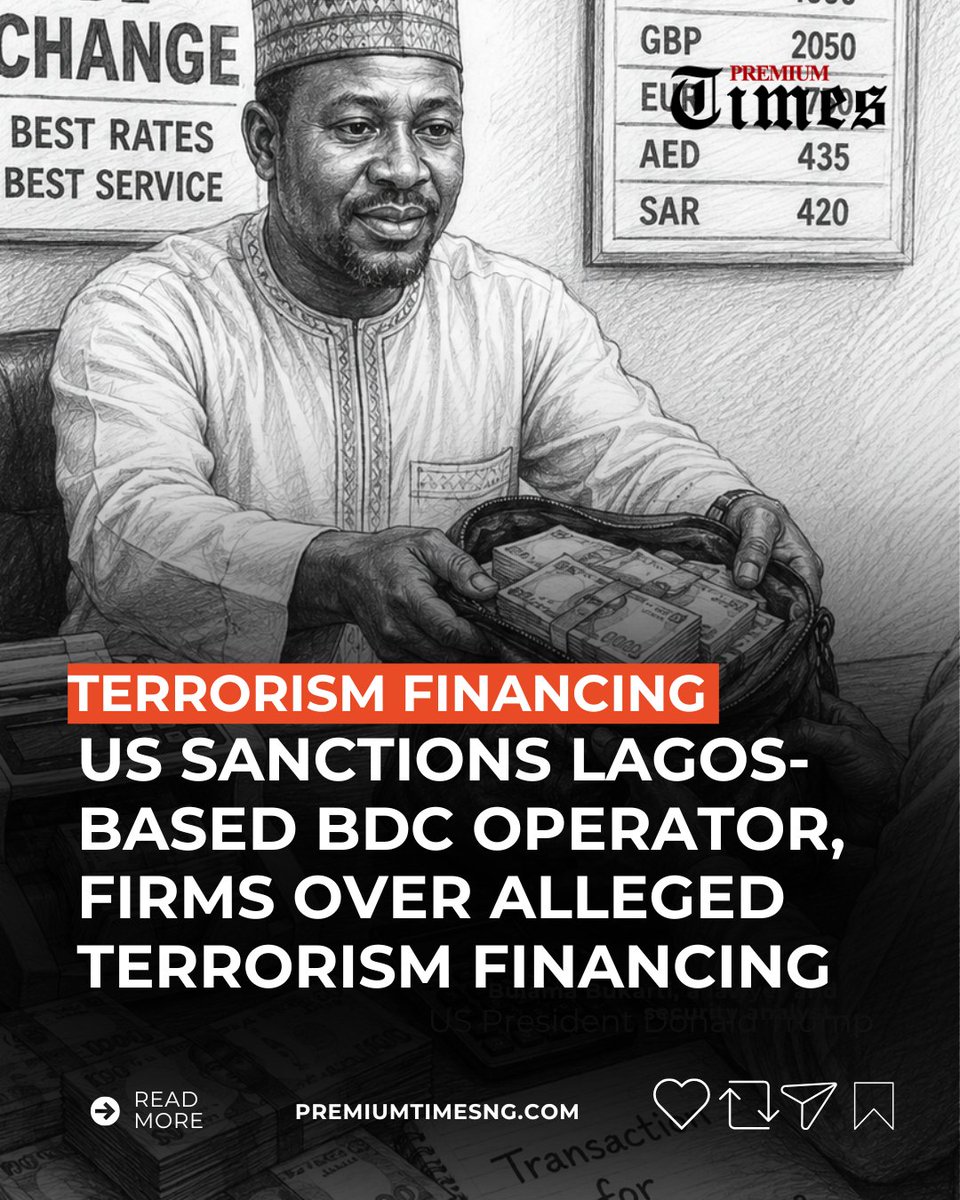
The Economic and Financial Crimes Commission (EFCC) was already aggressively investigating a prominent Lagos-based Bureau De Change (BDC) operator, Mukhtar Adamu Muhammad, alongside three corporate entities tied to him, long before the United States government stepped in with fresh international sanctions. Highly placed sources within the anti-graft agency confirmed that the commission had wrapped up the core components of its intelligence gathering and was already preparing formal criminal charges when Washington made its public declaration.
This internal disclosure comes on the heels of a major counter-terrorism move by the United States Department of State, which officially blacklisted Muhammad and his firms, designating them as primary financial facilitators for the Islamic State of Iraq and Syria (ISIS). The heavy international sanctions form part of a coordinated global crackdown aimed at crippling an intricate web of cross-border financial channels used by ISIS to bankroll operations across West Africa, Europe, and the Middle East.
According to an official briefing by U.S. State Department spokesperson Thomas Pigott, the synchronized sanctions target high-risk networks spanning Nigeria, France, Syria, and Türkiye. Under Executive Order 13224, the newly active sanctions immediately freeze any assets or property interests belonging to Muhammad and his companies within U.S. jurisdictions, while strictly banning American citizens or corporate entities from engaging in any future financial transactions with them.
Closer to home, the Nigeria Sanctions Committee has formally thrown its weight behind the asset-freezing updates announced by the U.S. Office of Foreign Assets Control (OFAC). The committee revealed that the international clampdown directly follows Nigeria’s independent domestic designation of these exact actors on the Nigeria Sanctions List. The local blacklisting was heavily backed by deep inter-agency assessments, financial audits, and undercover intelligence, which firmly established that the suspect actively facilitated and moved capital to sustain the operations of the Islamic State West Africa Province (ISWAP).
The federal government has routinely updated its blacklists to include key facilitators such as Ibrahim Yakubu Ogirima, Muktar Muhammad Adamu, Adamu Chiroma, Ibrahim Abubakar, Abdullahi Umar Usman, and Babangida Muhammed Adamu Hammajam. Corporate entities swept up in the asset-freeze directive include Abbal Bako & Sons Bureau De Change Limited, Generation Currency BDC Limited, and Nine to Nine BDC Limited.
In a firm directive aimed at maintaining the integrity of the national financial system, the federal government has ordered all commercial banks, financial bureaus, and designated non-financial businesses to strictly enforce asset-freezing mandates. Financial institutions have been instructed to ramp up Suspicious Transaction Reports (STRs) and immediately flag any matching data to relevant authorities. The Nigeria Sanctions Committee highly commended the joint efforts of the Federal Ministry of Justice, the Office of the National Security Adviser (ONSA), the Central Bank of Nigeria (CBN), the Department of State Services (DSS), the EFCC, and the Nigerian Financial Intelligence Unit (NFIU) for their relentless inter-agency synergy in keeping terrorist groups starved of vital operational funds.