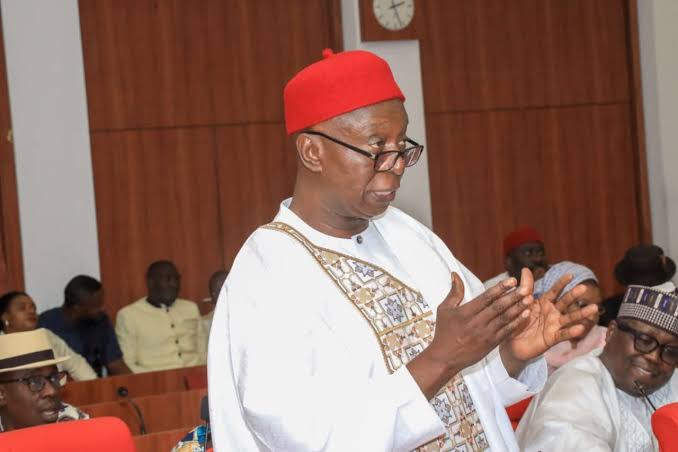
The Anioma people of Delta State has reacted to the recent bill by Senator Ned Nwoko representing Delta North Senatorial District, to carve Anioma State from the present Delta State in the South-South region, and create it as the sixth state in the Southeast region.
In a statement on his advocacy for the new state, Nwoko said: “Anioma is composed of nine local government areas, six of which are rich in oil and gas resources. It boasts significant human capital, making it a viable and sustainable candidate for statehood. Creating Anioma state is not just about increasing the number of states, but ensuring fair representation and resource allocation for the South-East.”
“The call for Anioma State has widespread support from various stakeholders. The Anioma socio-cultural group, Izu Anioma, and the pan-Igbo cultural organisation, Ohanaeze Ndi Igbo, have both been vocal in their advocacy for this cause.
“Anioma State is coming. The widespread affirmation from our people drowns the few voices of dissent. I am happy that democratic forces and critical stakeholders are backing the proposal. Community leaders, youths, women, and various groups want Anioma.
“The political class in Anioma, including traditional rulers led by the late Asagba of Asaba, Obi (Prof) Chike Edozien, have also consistently supported the creation of Anioma State. They have held numerous meetings, including discussions with former President Olusegun Obasanjo, to voice their consensus,” he stated.
However, the Pan-Ndokwa socio-cultural organisation, Ndokwa Neku Union (NNU) led by a retired military officer, General Mike Ndubisi, has distanced itself from the Ndokwa ethnic nationality from the bill because of the configuration with South-East.
Similarly, the suggestion that the new state be a part of the South-East geopolitical zone was also rejected by Dr. Norris Ovili, president of the Ndokwa Study Group, who asserted that the proposed Anioma State should only contain regions west of the Niger, notably the former Aboh and Asaba Divisions.
In a related development, the Ika ethnic nationality also turned down Senator Nwoko’s bill, saying: “In principle, we support the creation of states, particularly Anioma State that does not bestride any part of Eastern Region. Taking all the determinants required for state creation, the four local government areas that make up the original proposed Anioma State eminently satisfy all the requirements.”
On their part, the Head of Collective Leadership of Onu Ika, Nigeria (HCL), Elder Daniel Usifoh, and others in a statement, said: “We, therefore, humbly request our distinguished senator, Ned Nwoko, to revisit his proposed bill for the creation of Anioma State, particularly the ‘geographical coverage’ or contrived annexation of Anioma State to Eastern region.”
The Ikoro-Agbor, comprising of the youths of the entire communities in Agbor Kingdom in a protest letter to President Bola Tinubu and President of the Senate, Godswill Akpabio, stated: “We affirm that Senator Ned Nwoko did not consult with the people of Agbor before issuing his proposition of a prospective Anioma State joining with the South-East in a new region in Nigeria.”
Johnson Imade and others in the letter, explained: “By this publication, we express our disapproval of Senator Nwoko’s conduct of taking such far-reaching and binding political decision without prior consultation with the principal stakeholders of the Anioma region.
“The mandate of Senator Ned Nwoko, representative of Delta North in the 10th Senate of the Republic of Nigeria does not include any permission to railroad or bond the Delta North or Anioma people to a political union with South Eastern Nigeria without the democratic consent of the people expressed in a plebiscite.
“We hold that any re-arrangement in the political affiliation of the Delta North Senatorial District will require a plebiscite to seek a democratic validation as was done before the creation of the Midwest Region in 1964. Agbor was an integral part of that epochal political experience.”