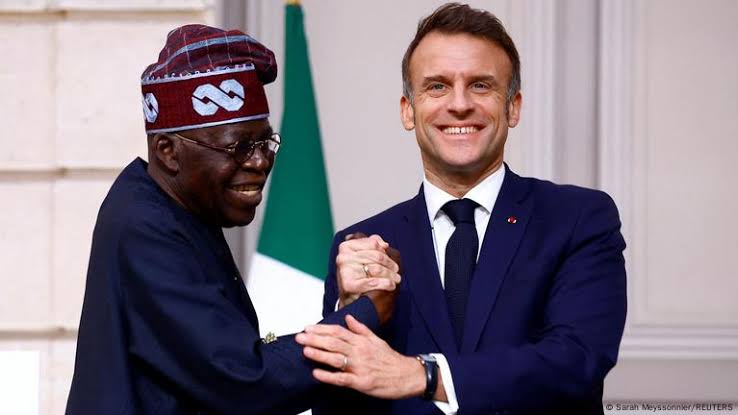
President Bola Ahmed Tinubu of Nigeria and French President Emmanuel Macron held a private working lunch at the Élysée Palace in Paris on Wednesday, September 10, 2025. The meeting came as part of President Tinubu’s 10-day working leave, which he is spending between France and the United Kingdom.
This latest interaction highlights the growing importance of Nigeria-France ties, with President Tinubu making France a frequent stop since taking office in May 2023. In fact, this marks his seventh visit to Paris in just over two years, a clear indication that France occupies a strategic place in Nigeria’s foreign policy under his administration.
Warm Welcome and Strategic Dialogue
Official photos released by the Nigerian State House captured a cordial handshake between Tinubu and Macron at the palace entrance, symbolizing the friendly tone of the encounter. Though the meeting was closed to the press, it was described as both productive and forward-looking. Analysts believe the discussions likely expanded on ongoing diplomatic, economic, and security collaborations.
Tinubu’s repeated engagements with Macron suggest an effort to solidify Nigeria’s role as a central partner for France in West Africa. For Nigeria, the relationship offers a pathway to attract investment, strengthen trade, and deepen security partnerships in a rapidly changing geopolitical environment.
Likely Discussion Points
While the French presidency did not disclose a formal agenda, the themes of previous meetings between both leaders provide strong indications of what dominated their talks:
- Economic Cooperation and Investments
President Tinubu has consistently emphasized foreign investment as a cornerstone of his economic reform agenda. France, with its longstanding commercial footprint in Africa, remains a key target for Nigerian investment drives. Their discussions likely touched on opportunities in agriculture, energy, digital technology, and infrastructure—sectors where French expertise could accelerate Nigeria’s economic diversification and job creation goals. - Regional and Global Security
Security challenges across the Sahel and West Africa continue to be a pressing concern. With France traditionally playing a prominent role in the region’s counterterrorism efforts, collaboration with Nigeria—the continent’s largest economy and one of its most influential states—remains crucial. The leaders are believed to have explored joint strategies to combat terrorism, insurgency, and transnational crime. - Climate Change and Energy Transition
Nigeria is actively seeking partners to support its energy transition efforts while balancing its role as a major oil producer. Macron, whose government has championed renewable energy and green finance, has previously expressed willingness to assist Nigeria in developing sustainable energy alternatives. Their conversation likely revisited areas of cooperation on climate adaptation, renewable projects, and innovative financing for clean energy initiatives. - Strengthening Bilateral Ties
Beyond policy and economics, Nigeria and France have shared interests in expanding cultural and educational exchange. France already plays an important role as a trade partner, and both countries have been working to build stronger diplomatic and cultural connections. Tinubu’s continued visits to Paris underscore the importance of institutionalizing these ties at multiple levels.
Broader Foreign Policy Context
Tinubu’s repeated trips to France highlight a deliberate diplomatic strategy. Paris is more than just a European capital—it is a bridge to the wider European Union and a key power with deep influence in Africa. For Nigeria, deepening this relationship helps boost its international clout, while for France, stronger ties with Nigeria offer stability and partnership in a region of increasing global interest.
This private lunch comes at a pivotal time, as Nigeria seeks to project itself as both a regional leader and a reliable global partner. Tinubu’s administration has consistently linked international diplomacy with domestic benefits, from economic reforms to security gains. His personal rapport with Macron reflects an effort to translate international goodwill into tangible progress for Nigerians.
Looking Forward
Although the details of the discussions remain private, the symbolism of the Paris lunch carries weight. Frequent direct dialogue between Tinubu and Macron signals continuity, trust, and shared ambition. Both leaders appear committed to turning cordial relations into concrete partnerships that deliver long-term benefits.
As Tinubu continues his working leave in Europe, observers anticipate that follow-up engagements may bring about new trade deals, stronger defense cooperation, and further collaboration on sustainable development. For now, the private lunch stands as another milestone in a relationship that has become a centerpiece of Tinubu’s foreign policy.
With this seventh visit to Paris, President Tinubu has left no doubt that France will remain a cornerstone of Nigeria’s diplomatic and economic outreach. His lunch meeting with Macron not only reinforces existing ties but also sets the stage for deeper collaboration in the years ahead.